
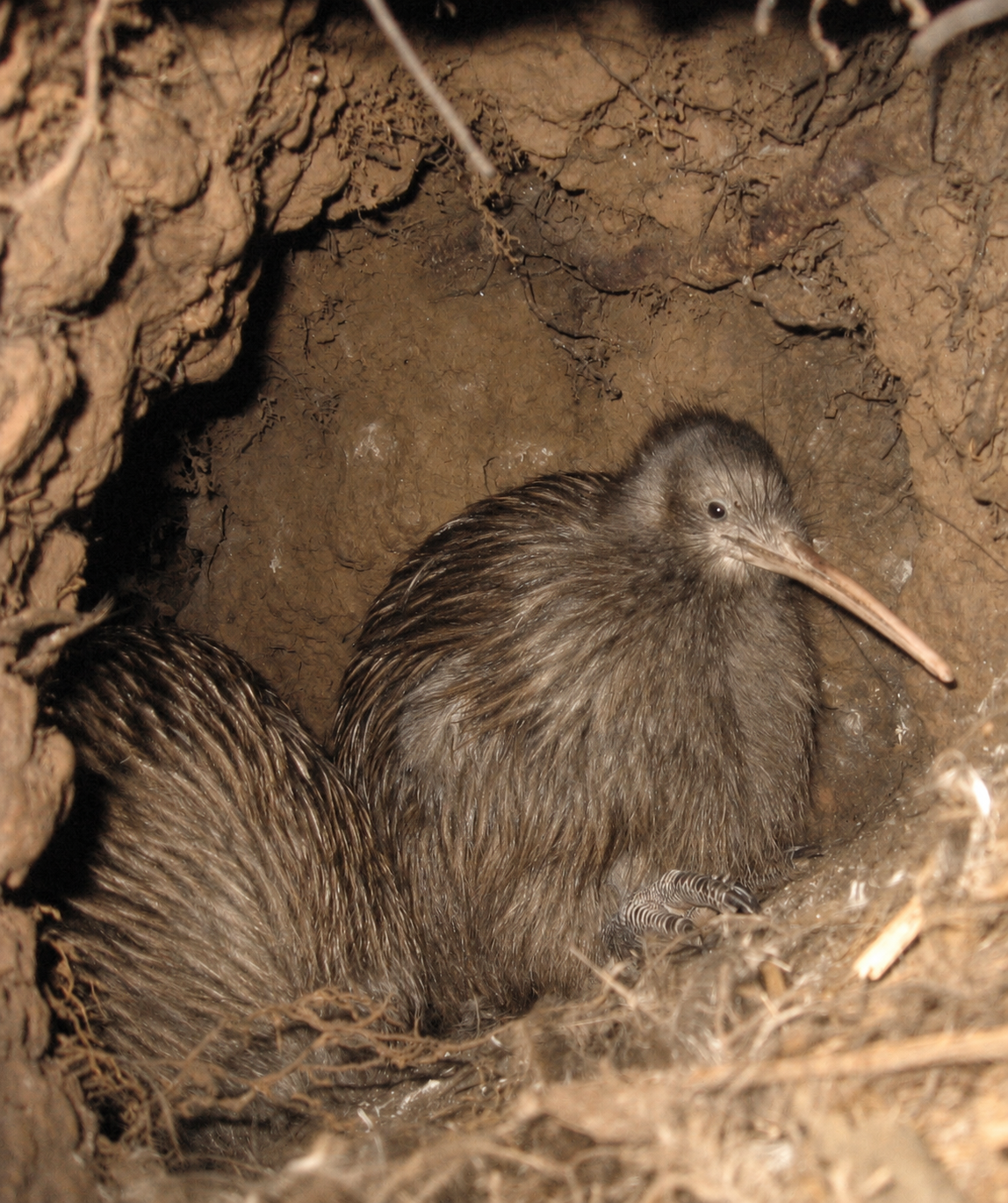

Kiwi are a ground dwelling, slow growing, smelly flightless bird. All of these facts mean they are vulnerable to many predators and man made habitat changes.
Predators
The predators that threaten kiwi may vary with age and bodyweight.
The most dangerous predator for kiwi chicks will be the stoat. These are 1 of the 3 mustelids introduced into New Zealand to attempt to control rabbit plagues. The stoat is a fearless predator, taking on prey over 6 times its bodyweight. They are clever, wary predators that can climb and swim. Stoats are very active both day and night and always seem to be on the move - they are fast and often seen running across roads or tracks. Their usual kill technique is to bite the back of the neck, often after a chase.
Up to 95% of kiwi chicks in unprotected areas are killed by stoats. They are regularly seen on nest trail camera footage visiting the nest waiting for the egg to hatch.
Stoats have a very different reproductive physiology than than the other 2 NZ mustelids, ferrets and weasels. Stoat have "delayed implantation". While they are still in the den with their mother, and before their eyes are open, the female kits, and mother, are mated by a roving male stoat. This pregnancy then goes "on ice" until the environmental conditions are right for the pregnancy to continue. Stoats are often mated around October - November and will not have their kits until the next October when food is readily available, usually small birds and rats breeding up in the spring. The number of kits born will vary depending on food availability but can be 7 or more. This clever mating strategy means a single female stoat can disperse from her natal territory and start a whole new population somewhere else without needing to pair up with a male.
Stoats have large home ranges (female 80ha, male 300 ha) and are one of the most difficult predator to control. Trapping is widely used but the strategic use of secondary toxins will be needed as well. Stoats readily become "trap shy" meaning they avoid traps, and they also teach their young to avoid traps as well. Catching a female stoat is always cause for celebration as it often means 7 or more potential stoats are also gone from the population.
Adult kiwi can be up to 3 kg bodyweight and they have strong legs and sharp claws to protect themselves. Once a kiwi is over 1200gm it is generally considered big enough to successfully fight a stoat off. It takes 6 months from hatching to get to this size so chicks are vulnerable for a long time.
The predators threatening all ages including adult kiwi are ferrets (the biggest mustelid in NZ), feral cats and dogs.
Ferrets are not good climbers or swimmers, they are also more easily caught than stoats but they have a greater impact on kiwi populations as they kill breeding age birds. Ferrets are not common in Northland, but are numerous in the South Island and parts of the lower North Island. They tend to be found where there are rabbits in large numbers.
Dogs are the biggest killers of kiwi in Northland. They will kill all ages of kiwi but, as with ferrets, the loss of breeding adult kiwi means the population can crash very quickly.
Dogs are present in most habitats in Northland: farm, hunting and pet dogs do regularly encounter kiwi. In some areas kiwi are literally in people's back yards so pet dogs will encounter them. Kiwi are exciting to dogs; they smell unusual, they run and they are often in strange places during the day. Once a dog has killed a kiwi, they will generally keep killing them; the thrill of the chase and kill is a powerful motivator. Any dog cam kill a kiwi.
There is no easy fix for the loss of kiwi due to dogs as there are so many different threads but:
- making sure dogs are under control at all times,
- limiting their access to kiwi where possible
- having regular Kiwi Avoidance Training will all help.
We offer a free workshop for dog owners, "Know Your Dog", to help dog owners have a better relationship with their dog by understanding them. This helps save kiwi and other endemic wildlife too.
Feral cats are the unseen kiwi predator. These apex predators are patient, wary hunters and are doing an awful lot of damage to our endemic wildlife. Not only are they killing our birds, bats and reptiles by predation, they are also killing them by spreading diseases like Toxoplasmosis and their roundworm. Kiwi have been killed by both these diseases. As cats poo in the environment they shed these 2 organisms and kiwi then inadvertently eat the roundworm eggs (in the soil or in invertebrates) or the Toxoplasmosis life stages that are infective. The kiwi brain (and lungs too with roundworm) are then affected resulting in their death.
Choosing not to have a cat, to ensure your cat is not free roaming (catios for example) and responsibly disposing of cat excrement will help our birds and their environment. Preventing your cat breeding and the release of unwanted cats into the wild goes a long way to helping too.
Habitat destruction
Kiwi are a remarkably adaptable species, they can live almost anywhere! The fact they are still living on the mainland suggests they are true survivors despite being flightless and vulnerable.
As more and more land is cleared for housing especially, kiwi are pushed out. They do not need large tracts of native bush to thrive, they survive well in pine forests, farmland with small native pockets and even around orchards, vineyards and lifestyle blocks. Simple things can mean kiwi still remain. Leaving small safe pockets for them to roost and nest, not draining summer safe swamps, clearing pine forests carefully being mindful kiwi could be there, not tearing pampas bushes out with a digger without checking first....all these will make a difference.
Kiwi are in bracken, gorse, pampas, drains and ditches, long kikuyu, scrub....they can be anywhere.
Droughts are particularly hard on kiwi, chicks especially, they can be found in unusual places even out during the day as they search for a dwindling food source. Saving wetlands or water courses can be the lifesaver. Climate change is going to severely impact kiwi survival.